

The Scandal That Put the Star-Spangled Banner in the Concert Hall
The Scandal That Put the Star-Spangled Banner in the Concert Hall
Before the first note of Beethoven or Brahms, the hall often rises for “The Star-Spangled Banner.” The custom began in a burning Baltimore harbor in 1814 and reached the concert stage after a wartime scandal brought down one of the most celebrated conductors in America.
- A poem written in the smoke over Baltimore.
- The conductor blamed for a song he never refused.
- How the anthem claimed the season opener.
- Why Stravinsky’s version drew the police.
At symphony concerts across the country, the conductor often turns to face the audience before the first piece. The whole hall then rises for “The Star-Spangled Banner.” Beethoven and Brahms never wrote with a flag ceremony in mind. So how did a patriotic song end up opening the symphony? The answer starts in a burning Baltimore harbor in 1814. It takes a sharp turn in 1917, when a famous conductor’s career collapsed over this very song.
A Song Born in the Smoke Over Baltimore
The story opens in September 1814, deep in the War of 1812. British warships pounded Fort McHenry in Baltimore Harbor through a long night of rockets and mortar fire. Francis Scott Key, a Washington lawyer, had sailed out to negotiate a prisoner’s release. He watched the whole bombardment from a ship he could not leave. When dawn broke on September 14, he saw the fort’s enormous garrison flag still flying. He began writing the verses he called “Defence of Fort M’Henry.” That flag survives today at the Smithsonian’s National Museum of American History.
Key never composed a melody. Instead, he fitted his words to “To Anacreon in Heaven,” the theme song of a London gentlemen’s music society. Americans already knew the tune well enough to sing on sight. Baltimore printers had the poem in the newspaper within a week. As the Library of Congress traces it, the pairing soon became one of the country’s most popular patriotic songs. It also gained a new name: “The Star-Spangled Banner.”
Throughout the nineteenth century, Americans sang it at Fourth of July celebrations and civic gatherings. The Civil War deepened its hold, because music carried enormous weight in a country fighting over its own identity. Key’s song became one of the anthems Union crowds reached for.
From the Flagpole to the Ballpark
The military gave the song its ceremonial weight long before Congress gave it a title. In 1889 the Secretary of the Navy ordered it played at morning flag-raisings, and the Army followed suit. In 1916 President Woodrow Wilson directed that it be played at military and official occasions. That order made it the national anthem in practice, if not yet in law.
Civilian life caught up fast. The song had turned up at ballparks for years, even at the very first World Series in 1903. The war gave it new force. In Chicago during Game 1 of the 1918 World Series, a Navy band played the anthem at the seventh-inning stretch. Red Sox third baseman Fred Thomas, on leave from the Navy, snapped to attention and saluted the flag. The crowd’s response turned that afternoon into baseball lore.
The paperwork finally arrived on March 3, 1931. That day President Herbert Hoover signed the law naming “The Star-Spangled Banner” the official national anthem of the United States. By then, Americans had been singing it for 117 years.
The Night the Anthem Came to the Concert Hall
If the custom has a turning point, it happened in Providence, Rhode Island, on October 30, 1917. The United States had entered World War I that spring. Anti-German feeling ran so hot that sauerkraut was being sold as “liberty cabbage.” That evening the Boston Symphony Orchestra arrived for a concert under its music director, Karl Muck. Muck was a celebrated German-born conductor who held Swiss citizenship.
Local women’s clubs had asked the orchestra to add “The Star-Spangled Banner” to the program. The request never reached Muck. The orchestra’s founder and chief executive, Henry Lee Higginson, turned it down on his own. He reasoned that patriotic tunes did not belong in an art concert. The next morning, the Providence Journal ran a front-page story claiming that Muck himself had refused to play it.
The accusation was false, but it ignited a national firestorm. Former President Theodore Roosevelt condemned the conductor, and protesters demanded boycotts of the orchestra’s Carnegie Hall dates. The orchestra soon added the anthem to its programs, but the uproar kept building. Federal agents arrested Muck in March 1918 and held him at an internment camp at Fort Oglethorpe in Georgia. He stayed there for more than a year until the government deported him in 1919.
The lesson landed hard on every orchestra in the country. Several ensembles had already started opening their concerts with the anthem that fall. After the Muck affair, playing it became a public declaration of loyalty that few music directors wanted to skip. Historian Melissa D. Burrage traces the whole episode in The Karl Muck Scandal. Her account makes clear that the concert-hall anthem grew less from tradition than from wartime pressure.
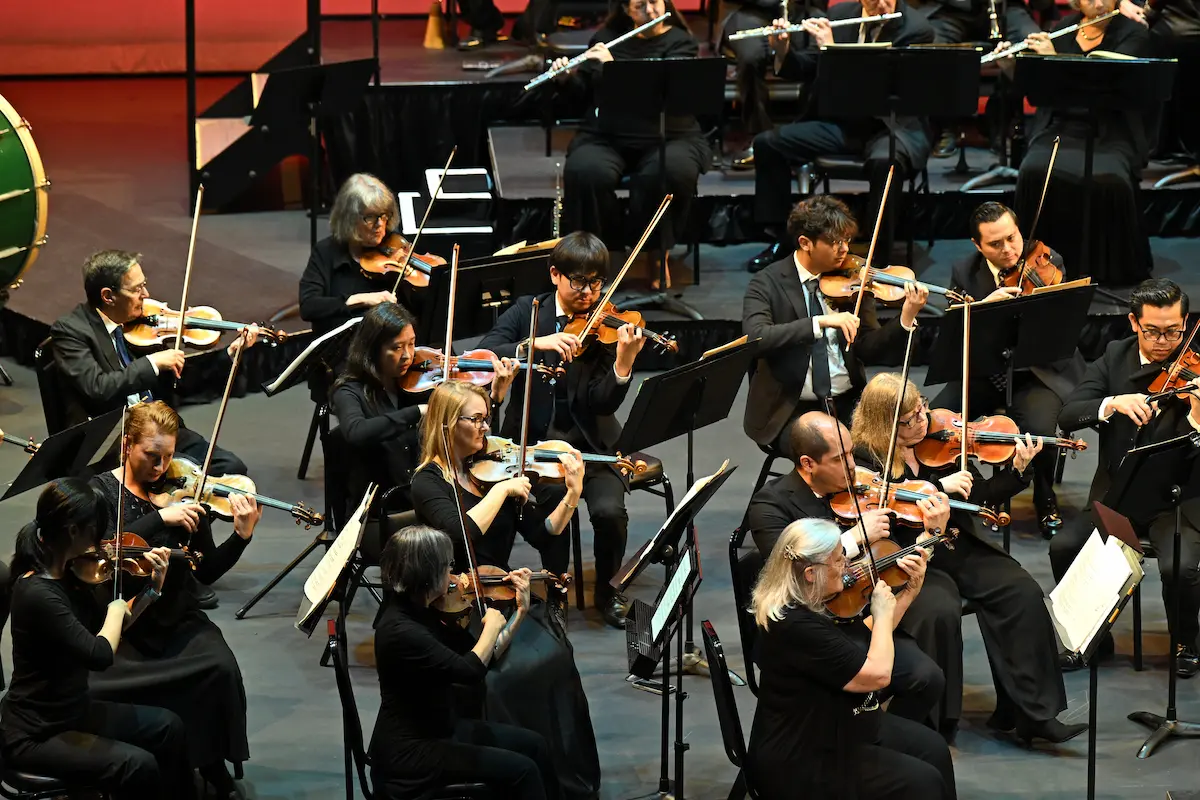
For a moment, the people in the seats stop being an audience and become a chorus.
La Mirada Symphony
How the Season Opener Became Its Home
No law or musicians’ rulebook ever told American orchestras when to play the anthem. Each one settled the question for itself. Over the following decades, the anthem found a natural home at the season opener, and the patriotic years of World War II sped that along. The first concert of the year already carried a sense of occasion. A shared moment of standing and singing gave the whole community a way to mark it.
By mid-century the habit had spread nearly everywhere. In a 2018 article, the Milwaukee Symphony Orchestra called it a custom observed by almost every American orchestra. The familiar snare drum roll before the first note serves as its cue. A retired Milwaukee bassist recalled that the orchestra already played the anthem on opening weekend when he joined in 1962. That was only the ensemble’s third season, and other orchestras had observed the custom for years before that.
That independence still shows. Some orchestras play the anthem every opening weekend. Others save it for Independence Day programs and outdoor summer concerts. A symphony concert is not a military ceremony, and each organization decides how the piece fits the evening and the community it serves.
Ninety Seconds That Take Real Craft
Everyone in the hall knows the melody, which is exactly what makes it tricky. The tune spans an octave and a fifth, a range that tests even trained singers. An orchestra has to support a few hundred untrained voices without burying them or racing ahead. Conductors weigh tempo and balance carefully. They give the brass its ceremonial ring while the strings and woodwinds fill in the harmony underneath.
Civilian performances require no single orchestral version, so libraries tend to collect several. The Milwaukee Symphony keeps eight arrangements in its music library, though most rarely leave the shelf. Even Igor Stravinsky tried his hand. In January 1944 he led the Boston Symphony in his own harmonization. Its unconventional chords drew a visit from a Boston police official, who warned him about a Massachusetts law against tampering with the anthem. The popular legend that officers arrested him is a myth. Still, the story shows how protective Americans could be about every note.
So the next time you hear the opening bars at a concert, listen closely. The melody never changes. Each arrangement and each conductor’s choices make the performance distinctly that orchestra’s own.
Where Music Meets Community
Trace the anthem’s path to the concert stage and you find a story about far more than one song. A lawyer’s poem about a battered fort grew into a military ritual long before it settled into American orchestral life. Along the way, a wartime scandal that cost a great conductor his career pushed it onto the concert stage.
What survived that turbulent history is the part audiences still feel. When an orchestra plays “The Star-Spangled Banner,” the people in the seats briefly stop being an audience. They become a chorus, standing together before the music they came to hear. Composers and conductors shape every classical concert, but so do the communities that fill the hall. Few customs show that more clearly.
The next time those opening notes sound, you will know the long road they traveled. Once the last chord fades and everyone takes their seats, another shared tradition begins: an evening of live orchestral music.
Further Reading
- The Star-Spangled Banner Encyclopaedia Britannica
- Bringing the “Banner” to Light Library of Congress
- First newspaper printing of the poem, 1814 Library of Congress, Music Division
- The Star-Spangled Banner flag Smithsonian National Museum of American History
- Flag Day and the Star-Spangled Banner Johns Hopkins University Press
- Baseball and the Star-Spangled Banner National WWI Museum and Memorial
- The anthem’s baseball ritual, myth and fact Star Spangled Music Foundation
- The anthem and the concert hall in World War I History News Network, University of Richmond
- The Boston Symphony and the 1917 anthem controversy John Jay Homestead
- The “Star-Spangled Banner” Hysteria of 1917 Bunk History
- The Star-Spangled Banner: An Opening Weekend Tradition Milwaukee Symphony Orchestra
- Stravinsky’s Star-Spangled Banner Wisconsin Public Radio