

Romantic Riches: How Brahms Connected Mendelssohn to Dvořák
The Back Catalog
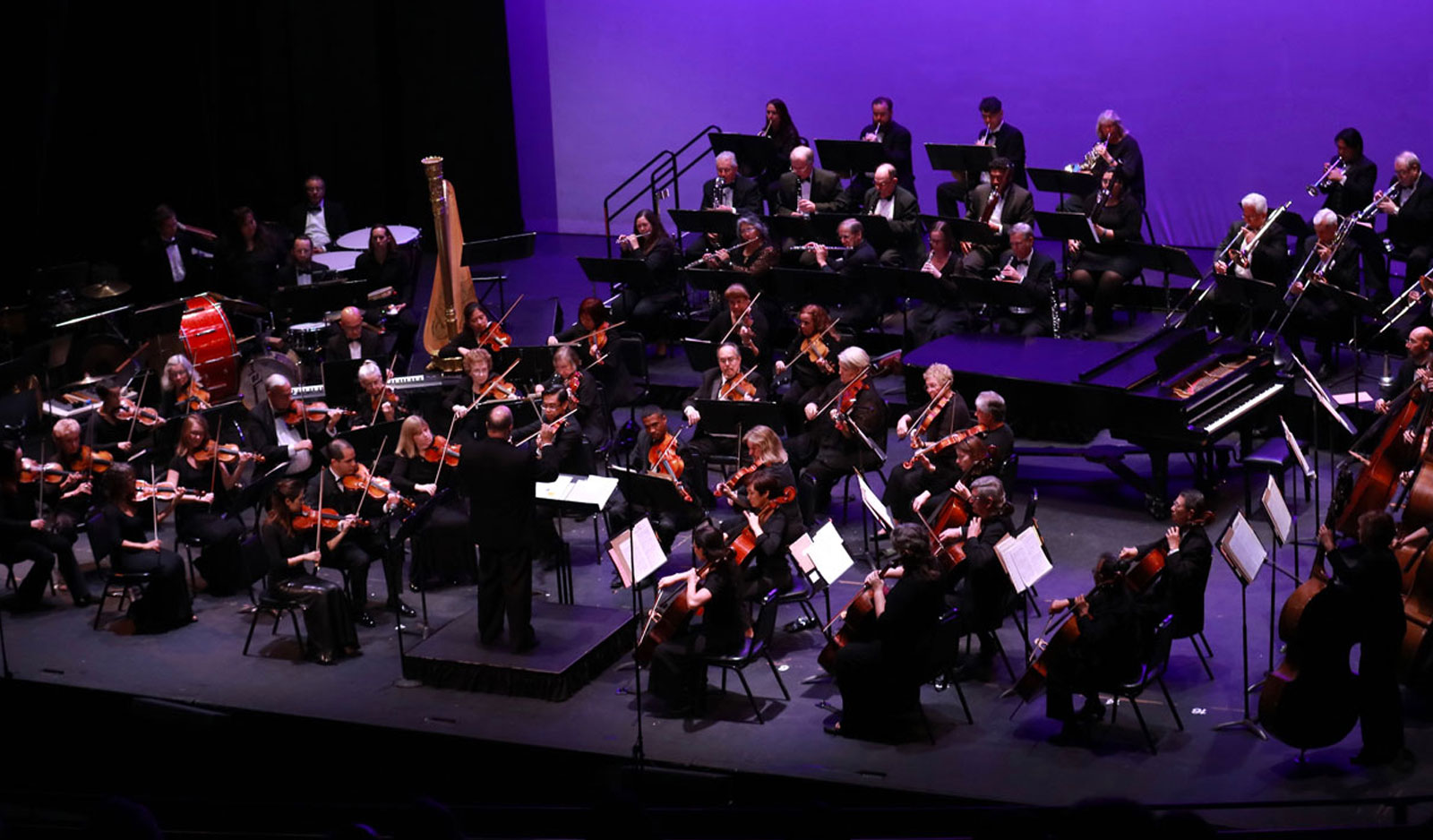 Cover Story
The La Mirada Symphony on the La Mirada Theatre stage with music director Alan Mautner during the 2017-2018 era.
Romantic Riches: How Brahms Connected Mendelssohn to Dvořák
A Liner Notes Report
In February 2018, the La Mirada Symphony built an afternoon around a very personal concerto. Brahms wrote it to win back his oldest friend, and his fingerprints cover the rest of the program, too.
On Sunday, February 25, 2018, the La Mirada Symphony played a program it called “Romantic Riches.” The Brahms Double Concerto sat at its center. A Mendelssohn overture opened the afternoon, and Dvořák’s Sixth Symphony waited after intermission. On paper, it looked like a handsome set of Romantic favorites.
Underneath, though, the afternoon told a single story. Johannes Brahms sits in the middle of it, and nearly every thread on the program runs back to him. He shared a hometown with Mendelssohn and launched the career of Dvořák. This Back Catalog entry revisits that concert, along with the history the original program notes had no room to tell.
A Seasick Start in the Hebrides
Felix Mendelssohn was 20 years old in the summer of 1829. After a run of successful London concerts, he set off through Britain with his friend Karl Klingemann. The pair worked their way north into Scotland, and Mendelssohn sketched and painted almost constantly. He worked in pencil and watercolor his whole life, much the way today’s travelers take phone pictures. On August 7, he wrote home from Tobermory, a harbor town on the Isle of Mull. Inside the letter, he scribbled a few bars of music to show how the Hebrides had moved him. Those bars became the opening of the overture.
Here’s the detail most program notes skip. He wrote that famous theme the day before he ever reached Fingal’s Cave. The visit itself came on August 8, aboard a steamer called the Ben Lomond. Mendelssohn spent much of the crossing miserably seasick. Klingemann later joked that his friend handled the ocean better as an artist than as a man with a stomach. The cave barely earns a mention in Mendelssohn’s own travel notebook, which says plenty about how the day went.
A Landscape Painted in Sound
Mendelssohn finished the score at the end of 1830 and revised it before a London premiere in May 1832. Along the way, the piece carried several titles, beginning with The Lonely Island. It eventually settled into the dual identity it still wears today. Some pages say The Hebrides, while others say Fingal’s Cave.
Despite the name, it isn’t an overture to any play or opera. It stands on its own as one of the earliest examples of orchestral landscape painting. The music offers a mood rather than a plot. In 2018 it opened the concert the way it has opened countless others. The low strings rolled in like a swell breaking against black basalt. Mendelssohn was born in Hamburg in 1809, and twenty-four years later Brahms arrived in the same city. That’s where the afternoon’s real story begins.
The Friendship That Broke
Brahms met the violinist Joseph Joachim in 1853. At the time, Brahms was a 20-year-old pianist with far more talent than connections. Joachim was already a star, and he opened doors for the younger man. His introduction brought Brahms into the home of Robert and Clara Schumann. For three decades, the two regarded each other as brothers in spirit. Joachim premiered the Brahms Violin Concerto and much of his chamber music. In return, Brahms trusted him with drafts he showed almost no one else.
Then came the divorce. In the early 1880s, Joachim grew convinced that his wife was having an affair. Amalie Joachim was a celebrated singer, and the man under suspicion was Fritz Simrock. Simrock happened to be Brahms’s own music publisher. Brahms didn’t believe the accusation for a second. He wrote Amalie a sympathetic letter that touched on her husband’s jealous streak. Amalie later produced that letter in court, and the ruling went her way. Joachim felt betrayed by the friend he had trusted most, and the two men stopped speaking.
A Peace Offering in A Minor
By most accounts, Brahms was not an easy man to stay friends with. He was even worse at apologizing, so he did what he did best. In the summer of 1887, at a lakeside retreat in Thun, Switzerland, he wrote a concerto for violin and cello. Composers had largely ignored that combination for decades. The cello part went to Robert Hausmann, a member of Joachim’s own string quartet. The violin part, of course, went to Joachim.
Brahms sent his old friend a nervous letter warning him to brace for a small shock. He also wove a coded tribute into the score. The notes F-A-E had long stood for Joachim’s personal motto, “free but lonely,” and Brahms rearranged them inside the music. It worked, at least enough to matter. After a September read-through in Baden-Baden, Clara Schumann called the piece a work of reconciliation. She noted that the two men were talking again for the first time in years.
Joachim and Hausmann gave the premiere in Cologne on October 18, 1887, with Brahms conducting. Later, Brahms gave Joachim a published copy inscribed “To him for whom it was written.”
Early audiences grumbled about the solo parts. They found them brutally hard and too often buried under the orchestra. Those complaints reveal how Brahms built the piece. He wrote the orchestra symphonically and treated the two soloists as one enormous instrument. They trade phrases and finish each other’s sentences until they land back in unison. The Double Concerto turned out to be his final work for orchestra. It sounds like a man who had decided some things were worth saying out loud.
Two Voices, One Conversation
For the La Mirada performance, the Symphony didn’t have to look far for its violinist. Sorah Myung was the orchestra’s concertmaster at the time, a chair she had held since 2014. She trained at Oberlin Conservatory and the Yale School of Music. In those years she juggled a full Southern California career. She taught at Vanguard University and the Orange County School of the Arts. She conducted the Community Youth Orchestra of Southern California as well. On top of that, she played assistant principal viola with the Mozart Classical Orchestra in Irvine. Her bio that season mentioned a plan to set foot on all seven continents. That may be the only goal on her list more demanding than the Brahms.

Greg Adamson carried the cello side of the conversation. His résumé stretched from the Hollywood Bowl and Disney Hall to Vatican City. He had shared stages with John Williams and Yo-Yo Ma, as well as The Who and Dr. Dre. In 2014, he founded the Fullerton String Orchestra. By the time of this concert, it counted more than 60 students from fourth through eighth grade. Most of them played at no charge, thanks to the All the Arts for All the Kids Foundation. He had also spent 15 years teaching K-6 music in Fullerton schools.
There was one more cellist in the room that afternoon. Music director Alan Mautner earned his degree in cello performance at Cal State Fullerton before he picked up the baton. A concerto that asks a cellist to stand up to a full orchestra had a sympathetic ear on the podium.
The Composer Brahms Vouched For
After intermission, the orchestra turned to the composer Brahms helped more than perhaps anyone. In 1874, a struggling Czech musician named Antonín Dvořák applied for the Austrian State Stipendium. The government grant went to artists who were young, gifted, and short on money. Brahms sat on the jury, and Dvořák’s scores stunned him. Dvořák won the award in 1875 and twice more after that.
In December 1877, Brahms wrote to his publisher and urged him to take on the young man’s music. He closed the pitch with a line that works as both compliment and nudge: “Moreover, he is poor!” That publisher was Fritz Simrock, the same man who later landed at the center of Joachim’s suspicions. Simrock’s catalog carried Dvořák’s music to an international audience.
The Symphony Vienna Turned Down
The Sixth Symphony grew directly out of that momentum. In 1879, Hans Richter led the Vienna Philharmonic in Dvořák’s Third Slavonic Rhapsody. Afterward, Dvořák promised the orchestra a symphony of its own. He wrote it between late August and mid-October 1880 and played it through at the piano for Richter. According to Dvořák, the conductor embraced him after every movement.
Then the Vienna players balked. Some of them reportedly objected to programming a new Czech composer two seasons in a row. As a result, the premiere slipped away. Adolf Čech conducted the first performance in Prague instead, on March 25, 1881. The audience demanded the scherzo again on the spot. The Vienna Philharmonic finally got around to the symphony in 1942, roughly 61 years behind schedule.
You can hear Brahms all through the outer movements. They echo his Second Symphony, also in D major, so closely that the resemblance plays like a thank-you note. The third movement belongs to Dvořák alone, though. It’s a furiant, a fiery Czech dance that refuses to sit politely in Viennese clothes. The Sixth became the first of his symphonies to reach print. It also made his name as a symphonist far beyond Prague. About a decade later he moved to New York to direct the National Conservatory of Music. There he wrote the “New World” Symphony and the “American” String Quartet. Then homesickness pulled him back to Bohemia.
Why the Program Still Holds Together
Read that way, “Romantic Riches” was really a program about the quiet ways one musician carries another. Brahms wrote his way back into Joachim’s life with a concerto. With a single letter, he also opened Simrock’s door for Dvořák. And on one Sunday afternoon in La Mirada, a concertmaster and a cellist stood at the front of the stage. Together they played the conversation Brahms never managed to have in words.

The musicians on that stage have moved on to other chairs and other stages since then. That’s part of what makes an archive worth keeping. The music hasn’t gone anywhere, and neither has the orchestra. Every La Mirada Symphony concert is still free at the La Mirada Theatre. See what’s coming up this season and pull up a seat.
From the Archive: The Program as Printed
La Mirada Symphony
Alan Mautner, Music Director and Conductor
Sunday, February 25, 2018, 3:00 p.m.
“Romantic Riches”
Felix Mendelssohn (1809-1847)
Overture to “The Hebrides” (Fingal’s Cave), Op. 26
Johannes Brahms (1833-1897)
Concerto for Violin and Cello in A minor, Op. 102
I. Allegro
II. Andante
III. Vivace non troppo
Sorah Myung, violin; Greg Adamson, cello
Intermission
Antonín Dvořák (1841-1904)
Symphony No. 6 in D major, Op. 60
I. Allegro non tanto
II. Adagio
III. Scherzo (Furiant): Presto
IV. Finale: Allegro con spirito
Support for the 2018 season came from the City of La Mirada and the Hennings-Fischer Foundation. The Los Angeles Public Library Art, Music and Recreation Department and the Musicians Union Local 47 Trust Fund also contributed.
 Liner NotesPutting the Opera Back in The Phantom of the OperaOct 26, 2026
 Liner NotesFive Things You Never Knew About The Phantom of the Opera (1925)Oct 19, 2026
 Liner NotesThe Scandal That Put the Star-Spangled Banner in the Concert HallOct 12, 2026