

Mikhail Glinka: The Father of Russian Classical Music
Liner Notes From the Archive
2018-2019 Season
Mikhail Glinka: The Father of Russian Classical Music
Before Tchaikovsky and Rimsky-Korsakov, there was Mikhail Glinka. Meet the sickly, homesick nobleman who gave Russian classical music its own voice.
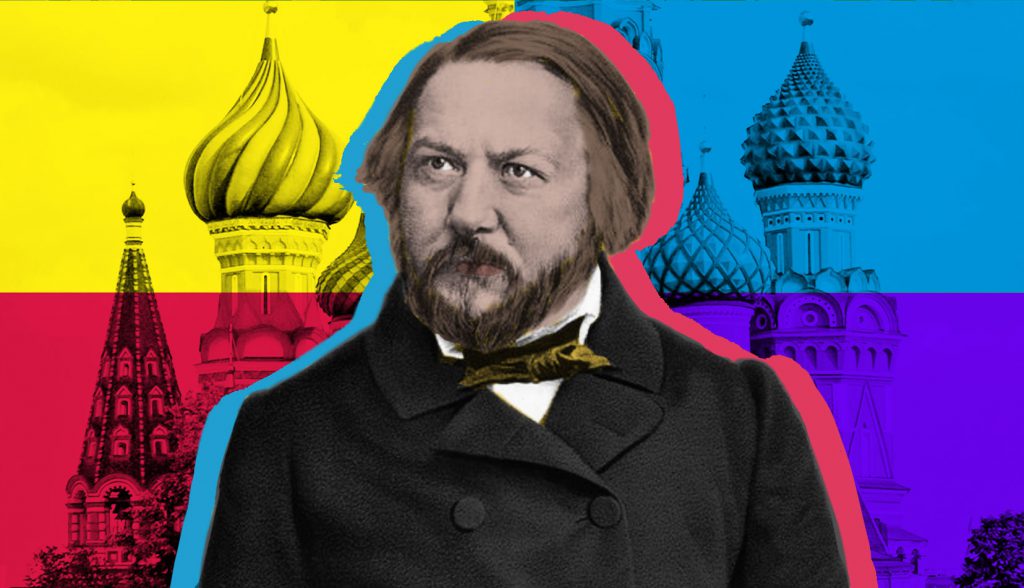
Every great musical tradition has a starting point, and for Russian classical music, that point is Mikhail Glinka. Before him, Russia’s aristocracy listened mostly to Italian opera, French ballet and German symphonies. After him, Russian composers had a sound of their own. Tchaikovsky, Rimsky-Korsakov, Mussorgsky and Borodin all built on the foundation he laid, and Britannica calls him the first Russian composer to win international recognition. Not bad for a man who spent much of his life convinced he was about to die of something.
A Sheltered Childhood
Glinka was born on June 1, 1804, at Novospasskoye, his family’s estate near Smolensk. His father was a wealthy landowner who had retired from the army as a captain. However, young Mikhail was raised mostly by his paternal grandmother, and her approach to childcare was memorable. She fed him sweets, wrapped him in furs and kept him confined to her room, which was always to be heated to about 77 degrees Fahrenheit. Unsurprisingly, the boy grew into a sickly adult. Later in life, he kept a rotating cast of physicians and fell for more than a few quacks.
Still, those early years gave him something valuable. Around the estate, he heard church bells and peasant choirs singing folk songs in rich, improvised harmony. At his uncle’s nearby estate, he heard a private orchestra play Haydn, Mozart and Beethoven. When he was about ten, a clarinet quartet by the Finnish composer Bernhard Crusell moved him so deeply that he later summed up the experience in four words: “Music is my soul.”
The Amateur Years
Like other young nobles of his day, Glinka learned violin and piano and took a few singing lessons. At 13, he went to St. Petersburg to attend a boarding school for sons of the nobility. While there, he also took three piano lessons from the Irish composer John Field, who had settled in Russia. His father, meanwhile, hoped for a respectable career. As a result, Glinka took a government post in the Department of Public Highways. Fortunately, the job demanded very little, which left him plenty of time for music.
He wanted to do for Russia what Bellini and Donizetti had done for Italy.
Finding a Russian Voice Abroad
In 1830, Glinka left for Italy, partly for his health and partly for his art. He studied briefly at the Milan Conservatory, where he found counterpoint tedious. More importantly, he met the leading opera composers of the day, including Vincenzo Bellini and Gaetano Donizetti. He also crossed paths with Mendelssohn and Berlioz. Yet the longer he stayed abroad, the more homesick he became. He decided that his mission was to return to Russia and write music in a Russian manner. In short, he wanted to do for Russia what Bellini and Donizetti had done for Italy.
On the way home, Glinka stopped in Berlin and spent about five months studying composition with the theorist Siegfried Dehn. Those lessons finally gave him the technical discipline his talent needed. By the time he reached St. Petersburg, he was ready to write an opera.
Two Operas That Changed Everything
A Life for the Tsar premiered in St. Petersburg on December 9, 1836. The story follows Ivan Susanin, a peasant who sacrifices his life to save the young tsar from Polish invaders. Audiences loved it, and for the first time, Russian folk melody stood at the center of a full-scale opera. The work became a national institution almost overnight.
Six years later, on December 9, 1842, Glinka premiered his second opera, Ruslan and Lyudmila. The plot came from a fairy-tale poem by Alexander Pushkin. In it, the knight Ruslan rescues his bride Lyudmila from an evil dwarf sorcerer. The music was bolder than anything Glinka had written before. He drew heavily on folk melody, and much of that borrowed material came from Eastern sources, giving the score an exotic color new to Russian ears. At first, the public responded coolly. Over time, however, the opera earned its place, and its overture became one of the most popular concert openers ever written. It races from the first bar to the last, and orchestras around the world still use it to start an evening with a jolt.
Spain, Kamarinskaya and the Acorn
Disappointed by the reception of Ruslan, Glinka traveled again. In Paris, Berlioz conducted excerpts from his operas. Then he spent two years in Spain, from 1845 to 1847, collecting folk tunes and absorbing the guitar music he heard. That trip produced two Spanish overtures, the Jota aragonesa and Summer Night in Madrid.
In 1848, he wrote Kamarinskaya, a short orchestral fantasy built on two Russian folk songs. It runs less than ten minutes. Even so, its influence was enormous. Forty years later, Tchaikovsky wrote in his diary that the entire Russian symphonic school was already contained in it, “just as the whole oak is in the acorn.”
A Legacy Larger Than the Man
Glinka spent his final years moving between St. Petersburg, Warsaw, Paris and Berlin, often living with his devoted sister, Lyudmila Shestakova. In 1857, he returned to Berlin to study old church music with Dehn. There, he caught a cold and died suddenly on February 15, 1857, at the age of 52. His sister later had his remains brought home to St. Petersburg, where he rests in the Tikhvin Cemetery at the Alexander Nevsky Monastery.
Today, Glinka’s name rarely appears in large type on a concert poster. Nevertheless, every Russian score that followed owes him something. The next time the Ruslan and Lyudmila overture opens a concert, listen for the moment the orchestra takes off. That rush of energy is where Russian classical music begins.
Keep Reading
Oct 5, 2026
Why Does Music Give You Goosebumps?
Sep 28, 2026
Why Did Russian Composers Become Obsessed With Spain?
Sep 21, 2026