

Why Is The Phantom Still Scary?
A century of horror movies has taught audiences what to expect. Somehow, Lon Chaney’s Phantom still gets under our skin.
The Phantom of the Opera 1925 has outlasted a century of horror trends that left most silent films behind. Prosthetics, animatronics, and computer-generated imagery have given modern filmmakers tools that Lon Chaney’s crew could scarcely have imagined, and those tools have produced vampires, zombies, aliens, and serial killers of every conceivable kind. Yet Chaney’s Phantom, emerging from the darkness in that original film, still unsettles audiences today.
The film turned 100 in 2025. More than a century after audiences first encountered Chaney’s Phantom, his face remains one of the most recognizable images in horror. So why does it still work? The answer may be simple: what makes The Phantom of the Opera frightening has very little to do with technology.
The Face We Aren’t Supposed to See
The film’s most famous moment arrives when Christine approaches the Phantom from behind. He sits at the organ, completely absorbed in his music, while she reaches toward his mask. Then she removes it, and Chaney turns.
For a modern audience accustomed to elaborate movie monsters, the image should almost feel quaint. Instead, it still lands. The sunken eyes, the distorted nose, the exposed teeth, and the almost skeletal face read as profoundly unnatural. The makeup alone doesn’t explain the effect, though. What really drives the scene is that the film makes us wait to see it.
That anticipation proves crucial. For much of the story, the Phantom exists mostly in our imagination. We hear about him. Characters fear him. He moves through hidden spaces beneath the Paris Opera House. His mask lets us see just enough of a human being to wonder what lies underneath. Eventually, the movie answers the question it has spent an hour asking.
The unmasking is the scene most people remember from The Phantom of the Opera 1925, and Turner Classic Movies calls it perhaps the most memorable sequence in Chaney’s filmography. The achievement belongs entirely to practical craft. Chaney built the transformation through physical makeup techniques rather than digital effects. He used materials to exaggerate his cheekbones, alter the shape of his nose, and deepen the shadows around his eyes. No computer-generated monster stands between the actor and the audience. What we see is simply a human face that has somehow become something else.
Lon Chaney Understood Something About Fear
Chaney became famous for transforming his own appearance. That reputation earned him the nickname “The Man of a Thousand Faces.” But the makeup only tells half the story. Chaney himself supplies the other half.
Watch his body during the film, and the performance becomes clear. His hands curl, and his shoulders rise. Elegance can shift suddenly into rage. Even without a word of dialogue, we understand exactly what he is thinking.
That physical vocabulary was essential in silent cinema. An actor couldn’t lean on a whispered threat or a frightening line to do the work. Fear had to travel through the body and the face alone. Chaney mastered that language better than almost anyone working at the time.
His Phantom also stays disturbing for a second reason: Erik isn’t simply a monster. Music moves him, and creation drives him. He longs for affection and wants Christine to love him in return. For a few moments, the film even lets us feel sympathy for him. Then that longing curdles into possession. The line between wounded human being and dangerous monster grows uncomfortably thin. That ambiguity makes Erik far more interesting than a creature who is simply evil. It also gives him a lasting hold on the audience.
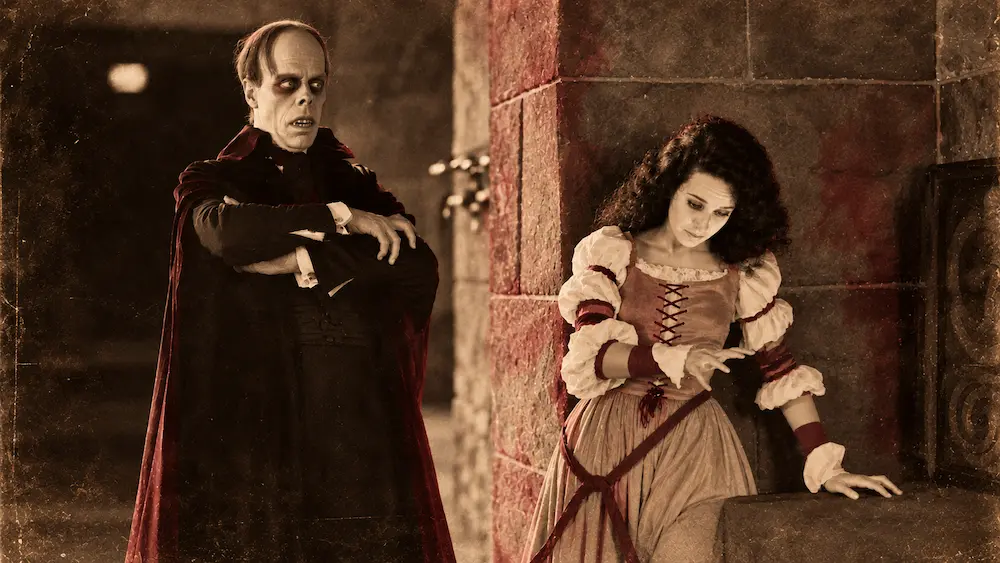
What makes The Phantom of the Opera frightening has very little to do with technology.A century later, the fear still works
The Opera House Is Part of the Monster
The setting deserves just as much credit as the performance. Above ground, the Paris Opera House glitters with chandeliers, costumes, dancers, and enormous crowds. Below it waits another world entirely, laced with passageways, dark corridors, underground rooms, water, and shadow.
Because the Phantom understands that hidden world so completely, he can seemingly appear anywhere within it. Universal built enormous sets for the production, including the Opera House interior, the backstage areas, and the grand staircase. The studio even shot portions of the film, including the masked-ball sequence, using an early two-color Technicolor process. The scale of the production matters. It turns the setting into a character in its own right.
Christine’s ordeal runs deeper than sharing a room with a frightening man. The Opera House itself has absorbed her, and getting free of him means finding a way out of an entire architecture built to contain her. That idea has echoed through horror ever since. An ordinary world conceals another one beneath it, invisible to everyone except the person unlucky enough to fall through. The monster who lives in that lower world doesn’t just occupy it. He built it, and mastered its darkness long before anyone else arrived. That mastery, more than any single threat, is what makes the Phantom frightening. He always knows the way. Christine never does.
Silence Can Make Horror More Uncomfortable
Modern horror films often signal exactly when to be frightened. The soundtrack drops away, a low rumble builds, the camera creeps toward a door, and then the sound explodes. A 1925 silent film works on entirely different terms.
An eerie distance separates the audience from the people on screen. Their mouths move, but we cannot hear them. Someone screams, yet the scream exists only in our imagination. That distance can make The Phantom of the Opera feel less realistic. Strangely, that same quality makes it feel more like a nightmare. Dreams don’t obey the rules of ordinary life either. Images appear without warning. People move strangely. Places seem enormous, something follows you, and sometimes there is no sound at all.
But Silent Movies Were Never Really Silent
Audiences in 1925 weren’t actually sitting in silence, because music carried much of the experience. Depending on the theater, a pianist, an organist, or a full orchestra accompanied the film. That accompaniment provided an emotional voice the screen itself couldn’t.
Live music changes the experience of watching The Phantom of the Opera considerably. A musician can stretch the tension as Christine moves toward the mask. The orchestra can swell until the enormous Opera House feels even larger, or shift suddenly to turn a strange image into something threatening. Unlike a recorded soundtrack, a live performance exists in the room with the audience. The musicians always know what is coming, even when the audience doesn’t. That relationship between image, music, and anticipation creates a kind of suspense that is difficult to reproduce anywhere else.
He always knows the way. Christine never does.The Opera House becomes part of the fear
Horror Doesn’t Have an Expiration Date
It’s tempting to judge an old film by everything invented after it. The effects aren’t as sophisticated, and cameras didn’t move the way they do now. Editing followed different rules, and no one had access to computer-generated imagery. None of those things, however, actually creates fear on its own.
Fear begins with something much older: darkness, isolation, the unknown, a face we aren’t supposed to see. It also begins with a person standing where we didn’t expect anyone to be, and the suspicion that something is watching us. The Phantom of the Opera understood those elements in 1925. That understanding may explain why the film earned a place in the National Film Registry in 1998, recognizing its lasting place in American film history.
It may also explain something more immediate. After more than a century of increasingly sophisticated movie monsters, we can still watch Christine reach toward that mask. We can still think exactly what audiences must have thought generations ago: don’t take it off.
Notice how the film builds fear without modern effects.
- The long delay before the Phantom’s face is finally revealed.
- Chaney’s physical performance: hands, shoulders, posture, and sudden shifts in movement.
- The contrast between the glittering Opera House above and the hidden world beneath it.
- The way silence turns screams and threats into something the audience has to imagine.
- The emotional role live music can play in stretching tension and releasing it.
- The final moments before Christine removes the mask.
Experience The Phantom of the Opera With Live Orchestra
On October 22, La Mirada Symphony brings The Phantom of the Opera 1925 back home. This is the kind of environment silent cinema was meant for: the big screen, with musicians performing live.
Stage to Screen: The Phantom of the Opera pairs the landmark silent film with live orchestral accompaniment at the La Mirada Theatre for the Performing Arts. More than a century later, the Phantom still waits beneath the Opera House. This time, the orchestra waits with him.
Explore the 2026–2027 Season