

The Lost Music That Made Silent Movies Come Alive
Scott Lasky and the Famous Players Orchestra are bringing back the forgotten music that once gave silent movies their heartbeat.
Long before audiences associated movies with the unforgettable scores of John Williams, Hans Zimmer, or Ennio Morricone, live musicians in the theater carried every film. Those orchestras didn’t simply accompany silent movies. They gave the pictures a heartbeat, shaping the suspense, romance, comedy, mystery, and drama audiences felt in theaters across America.
Today, much of that remarkable musical tradition has disappeared. But composer, conductor, and film music historian Scott Lasky has spent nearly twenty-five years helping bring it back to life.
As founder and music director of the Famous Players Orchestra, a Los Angeles–based nonprofit ensemble, Lasky is preserving one of cinema’s great forgotten art forms so modern audiences can once again hear the music that helped give birth to the motion picture industry.
When Going to the Movies Meant Live Music
During the 1910s and 1920s, going to the movies meant experiencing live music. Movie theaters across America employed orchestras, pianists, and organists to perform alongside silent films. Unlike today’s movies, silent films often did not travel with a single recorded soundtrack. Instead, theaters maintained libraries of published orchestral music, and musicians assembled scores to match the action unfolding on screen.
Between roughly 1914 and 1929, a remarkable early film-music industry emerged to supply those musicians. Publishers produced thousands of new compositions, arrangements, and adaptations of existing works specifically suited to motion-picture exhibition.
Theater musicians could draw from volumes of ready-made stock music and cues designed for virtually anything that might happen on screen: a chase, a love scene, a moment of suspense, a comic mishap, a mysterious arrival, or a dramatic confrontation.
Music for every mood on screen.
- Hurries for frantic action and chase sequences.
- Agitatos for tension, movement and nervous energy.
- Pathetic andantes for sorrow and emotional reflection.
- Love themes for romance and intimacy.
- Caprices and appassionatos for heightened dramatic color.
- Dramatic tensions and mysteriosos for suspense, danger and mystery.
A conductor or music director could select from this enormous musical vocabulary and construct a score around the film. As a result, audiences in different cities might watch the same movie but hear a completely different musical interpretation.
The same chase or romantic embrace could sound different from one theater to the next, depending on the musicians, the music available in the theater’s library, and the choices the person assembling the score made.
In this way, every performance became a collaboration between the images on the screen and the musicians performing in real time — a creative freedom that made silent-film accompaniment one of the most dynamic forms of live entertainment in early American cinema.
The pictures may have been silent. The theater never was.The sound of early cinema
Then the Movies Learned to Talk
With the arrival of synchronized sound in the late 1920s, and the rapid spread of talking pictures that followed, movie theaters began converting to the new technology.
The transformation changed Hollywood forever and made much of the enormous musical infrastructure surrounding silent cinema obsolete almost overnight.
Many theaters had accumulated extensive libraries containing thousands of pieces of orchestral music. As theaters converted for sound, they discarded much of that repertoire to make room for new equipment and a new era of filmmaking.
Publishers disappeared. Theater owners broke apart music libraries or threw them away entirely, and musicians stopped performing countless compositions.
Consequently, many of the composers who had created this extraordinary body of music slipped quietly into obscurity. Unlike the film composers who would become famous in later generations, studios generally did not credit silent-era composers on screen, and they rarely recorded their music.
So while the films survived, much of the music that originally brought those films to life did not — and an entire chapter in the development of film music was nearly lost.
One Musician’s Mission to Save a Forgotten Art
Scott Lasky refused to let that history disappear.
After decades of collecting original silent-era orchestral music and researching the composers who created it, he founded the Famous Players Orchestra, a Los Angeles–based 501(c)(3) nonprofit ensemble dedicated to performing and recording the orchestral repertoire originally heard in movie theaters during the silent era.
Its mission is both musical and historical: to revive a forgotten repertoire and introduce contemporary audiences to the composers whose work helped establish the language of film music.
Achieving that, though, requires more than simply performing old scores. It means locating music that has survived for more than a century, studying how theaters originally used it, understanding the musical conventions of silent cinema, and returning pieces that have gone unheard for generations to the concert stage and recording studio.
Through live performances and new recording projects, the Famous Players Orchestra lets audiences experience a musical world that once existed in thousands of movie theaters but has largely vanished from public memory.
The Forgotten Composers Who Invented Film Scoring
One of the most remarkable parts of this history is just how much music was written, and how completely history has forgotten many of the composers who wrote it.
Long before today’s celebrated tradition of Hollywood film scoring existed, these composers were already developing a musical language for the screen. They understood that music could tell an audience how to feel about an image: it could intensify suspense, make romance more intimate, make comedy funnier, or make a mysterious character entering a room feel dangerous before anything had actually happened.
In other words, these composers were exploring the musical techniques that modern audiences now take for granted while motion pictures themselves were still a relatively new art form.
Yet because studios seldom credited them and rarely recorded their music, many disappeared from popular memory. Recovering their work, then, doesn’t simply preserve old music; it restores an important part of the history of cinema.
New Recordings and a New Book
The Famous Players Orchestra is also working to make this music available beyond the concert hall. The orchestra has completed a new recording devoted to this remarkable silent-era repertoire, bringing music that once accompanied motion pictures more than a century ago into the recording studio for a new generation of listeners. The recording is forthcoming.
Alongside it, Lasky has written a new book, Music of the Photoplay: A Chronicle of Silent-Era Film Music, an extensive history of the early film-music industry.
The book explores how this musical culture developed and includes detailed biographies of thirty of the era’s most prominent composers — artists whose music movie audiences across the country once heard, but whose names have largely disappeared from film history.
Together, the orchestra’s performances, recordings, historical research, and Lasky’s forthcoming book represent an ongoing effort to preserve not simply individual compositions, but an entire musical culture.
Recovering this music doesn’t simply preserve old scores. It restores part of cinema history.A forgotten musical culture
The Phantom of the Opera Returns to the Concert Stage
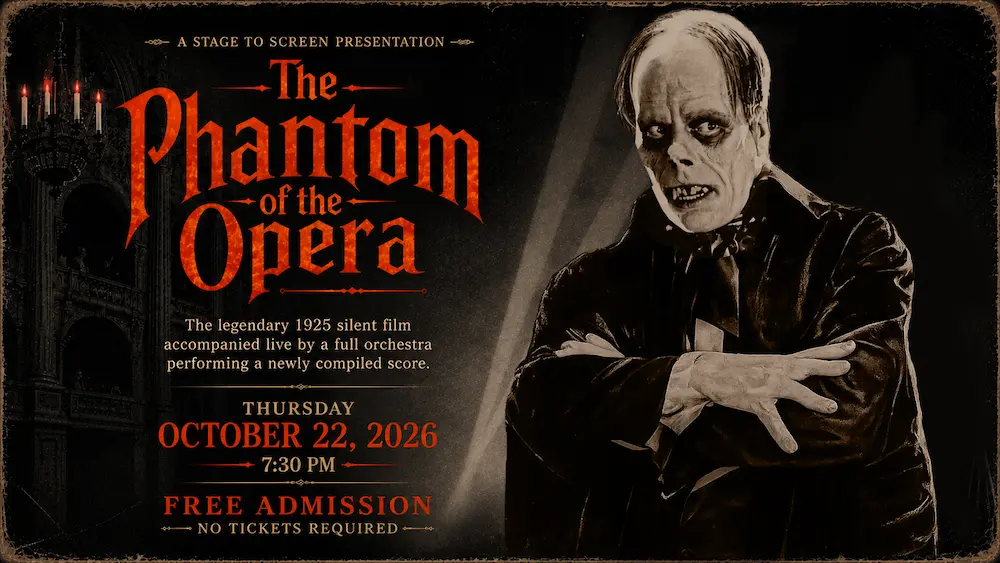
That forgotten musical tradition returns to the theater when The La Mirada Symphony presents the 1925 silent-film classic The Phantom of the Opera with a live orchestra.
For this special presentation, Scott Lasky has compiled and adapted the musical score, drawing primarily from the original theater repertoire of the silent era and supplementing it with some of his own compositions.
That distinction matters.
Rather than simply placing a modern soundtrack underneath a century-old film, the score draws on the same musical tradition that theater musicians used when silent cinema was alive on America’s movie screens.
Audiences will experience the legendary images of Lon Chaney’s Phantom accompanied by a live orchestra, with music rooted in the authentic repertoire of the period, bringing together two pieces of cinema history that were originally inseparable: the moving image and live music.
The Theater Was Never Silent
It’s easy today to think of silent films as movies without sound. For the audiences who originally experienced them, however, the movies were rarely truly silent.
The orchestra, organist, or pianist was part of the performance. Music established atmosphere before characters ever spoke through an intertitle; it could foreshadow danger, underline humor, heighten a dramatic revelation, or transform a simple glance between two characters into a romantic moment.
The musicians also created something today’s recorded soundtrack cannot: the unpredictability and immediacy of a live performance.
The film remained the same. The music lived in the room.
More than a century later, that relationship between screen and orchestra can still produce an extraordinary experience.
From Silent Cinema to the Modern Film Score
The music of silent films is more than a historical curiosity — it helped establish a fundamental idea that remains at the heart of filmmaking today: music can tell part of the story.
Long before John Williams made audiences believe a shark was approaching with two ominous notes, before Ennio Morricone redefined the sound of the Western, and before generations of composers created the sweeping scores associated with modern cinema, musicians and composers of the silent era were already discovering how powerfully music could shape what audiences saw and felt.
Their names may not be as familiar today, but their influence is everywhere.
Through the work of Scott Lasky and the Famous Players Orchestra, audiences now have an opportunity to rediscover that extraordinary musical heritage — and hear the sound of cinema before the movies learned to talk.
Experience The Phantom of the Opera with Live Orchestra
On Thursday, October 22, 2026 at 7:30 PM, The La Mirada Symphony brings the music and imagery of silent cinema together again with a special presentation of the 1925 classic The Phantom of the Opera.
The film will be presented with live orchestral accompaniment, featuring the score Scott Lasky compiled and adapted from music rooted in the original silent-era theater repertoire.
Admission is free, and no tickets are required.
To learn more about Scott Lasky, the orchestra’s preservation work, forthcoming recordings, and Music of the Photoplay: A Chronicle of Silent-Era Film Music, visit the Famous Players Orchestra.
Explore The Phantom of the Opera