
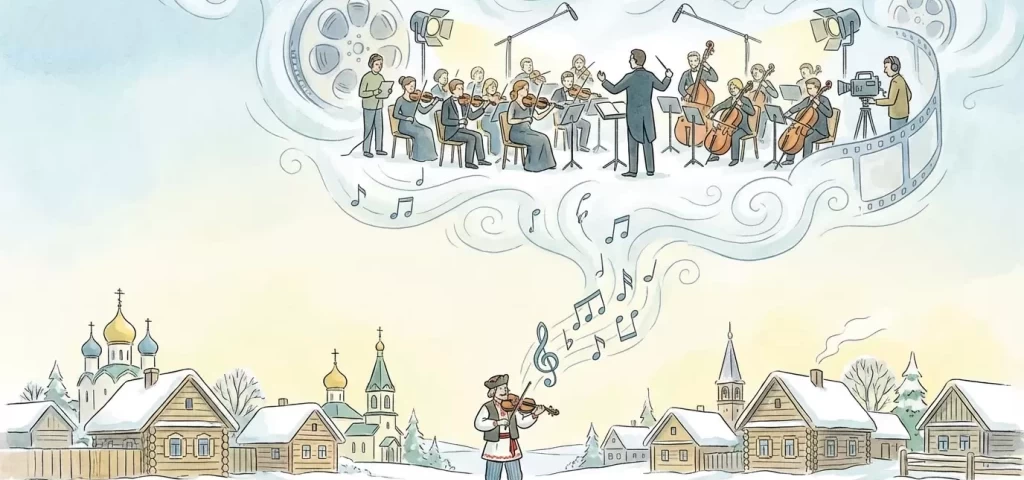
From Folk Villages to Film Scores
Eastern European music influence on film scores is not a modern trend—it’s the foundation of how we experience emotion in movies, streaming series, and video games today.
You’ve heard it before. A swelling minor key. A rhythm that feels slightly uneven—almost restless. Strings tightening beneath a moment of tension. What we call “cinematic” often began far from Hollywood, inside village traditions across Hungary, Romania, Poland, and the Balkans.
The Village Roots of a Cinematic Sound
Long before film studios shaped emotional storytelling, Eastern European music carried a distinctive intensity shaped by ritual, migration, and survival. Across the region, melodies were passed down orally for generations. In many traditions—especially in parts of the Balkans—uneven meters and propulsive dance rhythms weren’t experiments. They were cultural signatures: music that leans forward, refuses to sit still, and builds tension naturally.
In the early twentieth century, composers began preserving this tradition in a way that changed modern music. The Hungarian composer and ethnomusicologist Béla Bartók, often working alongside Zoltán Kodály, documented and transcribed thousands of folk melodies. The Budapest Bartók Archives (Institute for Musicology) maintains resources showing how directly these folk sources fed into Bartók’s compositions.
“What we now call cinematic was once village music played under open skies.”

Antonín Dvořák drew from the same principle: folk energy as structure. His Slavonic Dances explicitly name forms such as the furiant and dumka—regional dance and song patterns translated into orchestral scale. This is where the “film score feeling” starts: rhythm with personality, harmony with shadow, and melodies that carry identity.
A Premiere That Shook the Concert World
By 1913, orchestral music shaped by folk rhythm and raw momentum could no longer be dismissed as “local color.” On May 29, 1913, Igor Stravinsky’s The Rite of Spring premiered in Paris and triggered a famously chaotic audience reaction—often described as a riot or near-riot, depending on the historian’s caution. The date and the immediate controversy are widely documented, including by History.com.
Whatever label you attach to the night, the impact is clear: the music landed like a shockwave. Jagged rhythms and primal momentum challenged the idea that orchestral sound should be polite, symmetrical, and easily digested. What startled Paris would later become a perfect engine for cinematic tension.

“The modern film score did not invent its emotion. It inherited it.”
The Migration That Shaped Hollywood
Then history pushed artists across borders. Wars and political upheaval displaced European composers, and some arrived in Hollywood carrying the tonal DNA of European orchestral tradition. Erich Wolfgang Korngold helped define the sweeping sound of Golden Age adventure films. The Library of Congress has written directly about Korngold’s role in shaping early film music into a serious symphonic art, not just background accompaniment.
Another major figure, Miklós Rózsa, brought dramatic harmonic weight and orchestral intensity into American cinema, scoring films that helped define the sound of epics and psychological drama. Hollywood didn’t create orchestral emotion from nothing—it adapted a language already fluent in tension, longing, and release.
Why It Still Shapes Streaming and Gaming
Today, we live inside soundtracks: streaming series, fantasy franchises, anime, and open-world games that require music to carry atmosphere for hours at a time. Orchestral scoring remains the fastest way to signal consequence. Minor tonalities read as vulnerability. Unresolved harmony reads as suspense. A rhythmic pulse that “leans forward” reads as urgency.
This is why younger audiences don’t experience the orchestra as old-fashioned. They experience it as immersive. As scale. As emotional architecture. Eastern European color and rhythmic vitality still echo in the way modern scores move us—even when we don’t know the lineage by name.
“The orchestra isn’t old. It’s immersive.”
Hear the Source on March 22
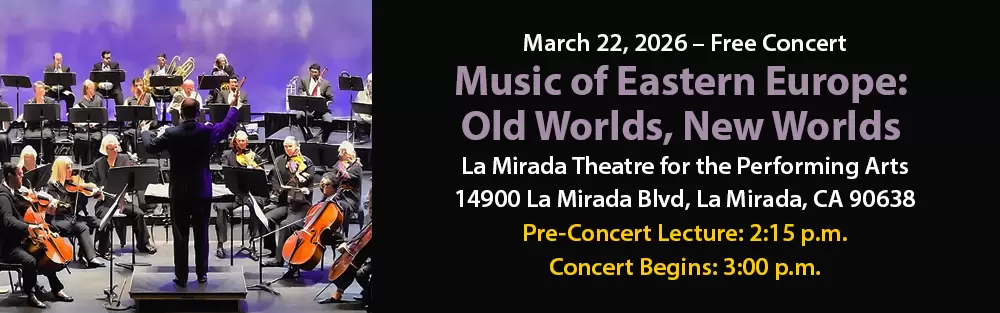
When the La Mirada Symphony presents “Music of Eastern Europe” on March 22, the program isn’t a museum piece. It’s closer to a source code reveal—the roots of a sound world we still depend on to feel modern storytelling.
If you’ve been following our articles and updates leading into the concert, this performance brings the history into the room itself. The difference between streaming and live music isn’t nostalgia. It’s vibration. In a hall, the air participates. The resonance is physical and shared.
Before Hollywood had a sound, Eastern Europe already did. And on March 22, you can hear where that sound began.